Small teams do not usually fail at social media because they lack ideas. They fail because execution gets fragmented. One post is drafted in a document, another sits in a chat thread, media files are spread across folders, and publishing depends on whoever happens to be available at the right moment. Once multiple networks are active, the work stops feeling creative and starts feeling operational.
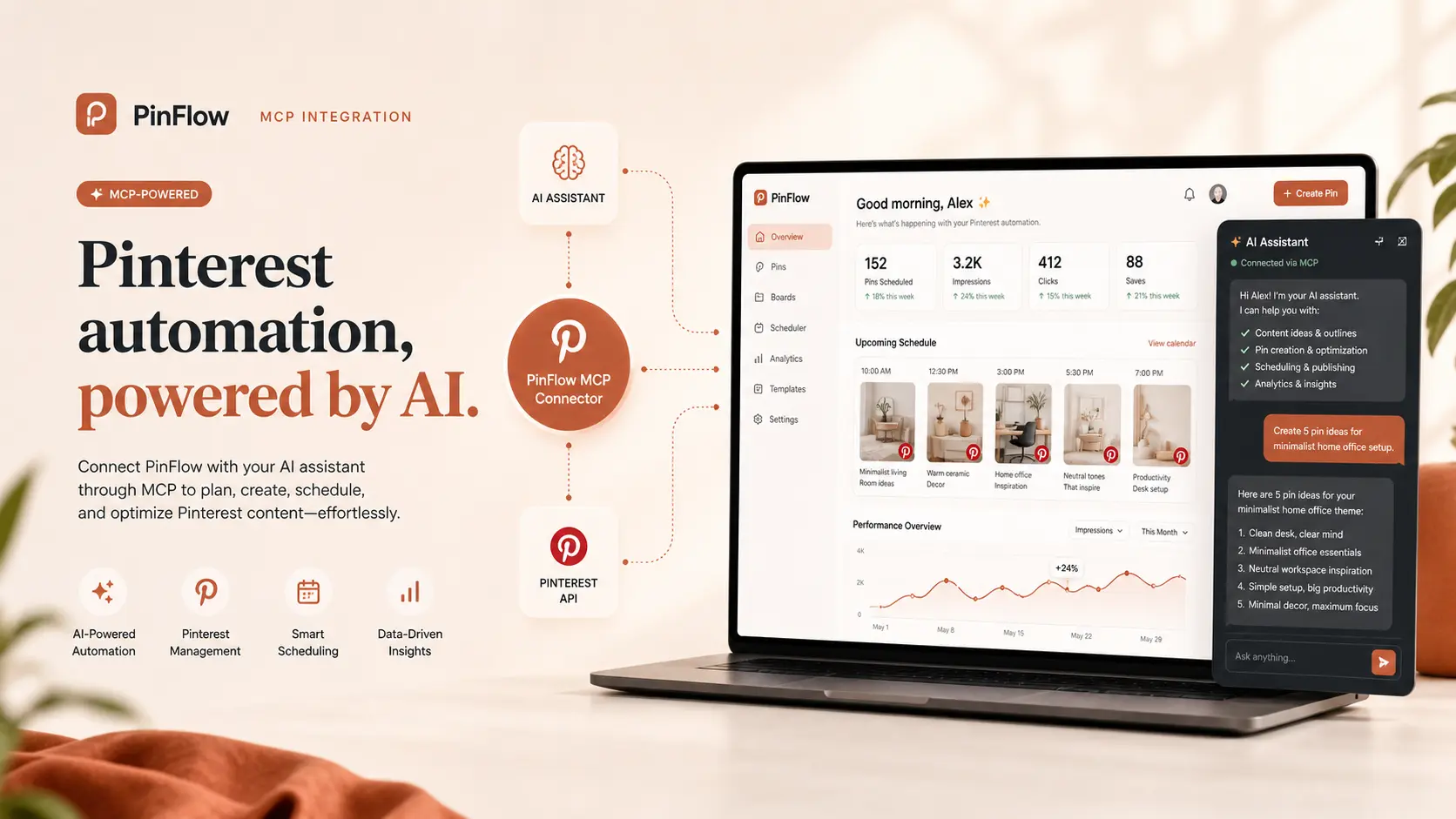
That is exactly where PinFlow becomes valuable. It is not just a scheduler. It is a publishing layer that helps a small team keep account context, media, timing, and publishing status organized in one place.
Why small teams lose momentum
The common problem is not volume. It is switching cost. A two- or three-person team can usually write enough content. What slows them down is moving between Pinterest boards, Instagram assets, Facebook pages, LinkedIn posts, TikTok videos, and YouTube uploads while also trying to keep campaigns consistent.
That fragmentation creates predictable issues:
- posts miss their intended time slot
- the wrong media is attached to the wrong account
- drafts get rebuilt several times for each platform
- failed publishes are discovered too late
When a small team has no clean operating system, every campaign feels heavier than it should.
Use one campaign source for every network
The cleanest approach is to stop treating each social network like a separate project. Start with one campaign source that contains the offer, target audience, destination link, creative assets, and publishing window. From there, adapt the content to the needs of each platform instead of rebuilding the campaign from scratch every time.
This is where small teams gain leverage. One campaign can become a Pinterest batch, an Instagram reel caption, a Facebook page post, a LinkedIn announcement, a TikTok publishing slot, and a YouTube upload workflow without creating six disconnected processes.
Give each platform a clear job
Small teams often waste time because they expect every network to perform the same role. A better model is to define the function of each one first:
- Pinterest: evergreen search and product discovery
- Instagram: visual engagement and short-form storytelling
- Facebook: page visibility and audience reach
- LinkedIn: authority, updates, and company narrative
- TikTok: short-form video distribution
- YouTube: long-form content and reusable video assets
Once the role of each network is defined, planning becomes simpler and copy quality improves because the team is not guessing what each post is supposed to do.
The four-part workflow that stays manageable
For most small teams, the best system is simple:
- Plan: choose the campaign, products, or offer for the week.
- Prepare: upload media once and write the core messaging.
- Schedule: adapt the content by platform and queue it in the right slots.
- Monitor: review failures, reschedule what slipped, and identify what worked.
This structure keeps the work from collapsing into reactive posting.
Why PinFlow fits this model
PinFlow is useful because it lets small teams stay inside one dashboard while still managing multiple networks, uploads, calendar views, and publishing states. That matters more than feature volume. The real operational win is reducing context switching.
Instead of bouncing between isolated tools, the team can work from one system to create posts, upload assets, schedule content, and review what failed.
Where automation helps most
Small teams should not try to automate everything immediately. The highest-value areas are usually:
- uploading media and reusing hosted URLs
- batching caption and post draft generation
- choosing the correct linked social account during publishing
- tracking scheduled, published, and failed content in one view
- connecting workflows through API, MCP, or n8n when volume grows
This is enough to save hours without creating a fragile system.
What to review each week
A small team does not need a long reporting ritual. One short weekly review is enough:
- Which posts were published successfully?
- Which posts failed and why?
- Which platforms are underused?
- Which media assets can be reused next week?
- Which campaign produced the strongest response or traffic?
The goal is not just to measure engagement. It is to protect operational consistency.
The real advantage
Most social media advice focuses on creative tactics. For small teams, the bigger advantage usually comes from cleaner execution. If the workflow is easy to repeat, the team publishes more consistently, catches failures earlier, and gets more value from every asset it already created.
Final takeaway
Small teams do not need a bigger content machine. They need a cleaner operating system. When planning, media handling, scheduling, and monitoring all live in one place, social media becomes easier to run at a high level without adding headcount. That is the practical promise of PinFlow.